Outlive by Dr.Peter Attia
Chapter 1: The Long Game - From Fast Death to Slow Death
Four Horsemen
It refers to the four chronic diseases of aging. The Four Horsemen are heart disease, cancer, neurodegenerative disease, and type 2 diabetes along with related metabolic dysfunction. Longevity means understanding and confronting these conditions. There is no point optimizing the rest if one of these gets you.
Lifespan and Healthspan
Longevity has two parts: Lifespan and Healthspan. Lifespan is how long you live in chronological terms. Healthspan is how well you live, that is, the period free from disability and disease, and more importantly, the period during which you still maintain decent physical and mental function. Remember the story of Tithonus, who was granted endless years but forgot to ask for enduring youth and vitality.
The goal isn’t just more years, but maintaining and improving physical and mental function across those years.
Chapter 2: Medicine 3.0 - Rethinking Medicine for the Age of Chronic Disease
Ignaz Semmelweis (The Doctor Who Was Right Too Soon)
In the 1800s, a Viennese physician named Ignaz Semmelweis became alarmed by the number of women dying soon after childbirth in his hospital. Searching for an explanation, he noticed a pattern. Doctors performed autopsies in the morning and then delivered babies later the same day, without cleaning their hands.
Although bacteria had not yet been identified, Semmelweis reasoned that something invisible was being carried from the dissection room to the maternity ward. He introduced mandatory handwashing, and mortality rates dropped sharply.
Rather than embracing his findings, many of his colleagues rejected them. His conclusions were uncomfortable and challenged established norms. He was isolated professionally and died in 1865, in an insane asylum.
In that very same year, Joseph Lister successfully demonstrated antiseptic surgical techniques, providing scientific grounding for what Semmelweis had already understood through observation.
Paradigms of Medicine
Attia frames the evolution of medicine as three paradigms: Medicine 1.0 (pre-scientific, acute care), Medicine 2.0 (evidence-based, chronic disease management), and Medicine 3.0 (proactive, prevention and longevity). The table below compares them across several dimensions.
| Dimension | Medicine 1.0 | Medicine 2.0 | Medicine 3.0 |
|---|---|---|---|
| Core Philosophy |
|
|
|
| Primary Goal |
|
|
|
| Mental Model |
|
|
|
| Time Horizon |
|
|
|
| View of Evidence |
|
|
|
| Approach to Risk |
|
|
|
| Treatment Strategy |
|
|
|
| View of Patient |
|
|
|
| Definition of Success |
|
|
|
| Relationship to Disease |
|
|
|
| Metaphor |
|
|
|
Mortality Rate and Medicine 2.0
This graph shows total mortality across the 20th century (dark line) and mortality after removing eight major infectious diseases (light line).
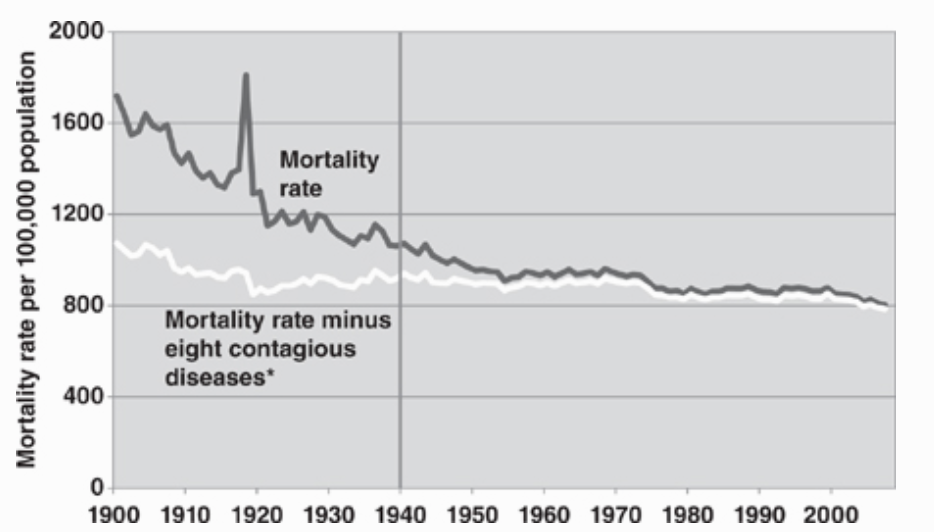
At first glance, mortality appears to decline dramatically. But once deaths from infectious diseases are excluded, the improvement becomes much smaller.
This suggests that most of the early gains in lifespan came from controlling infections through sanitation, antibiotics, and vaccines, the major successes of Medicine 2.0.
Against chronic diseases, however, progress was far more modest. The graph visually reinforces the book’s point that Medicine 2.0 excelled at fighting infections but made limited impact on the long-term diseases that now dominate aging.
Changelog
Updates to these notes.
- 2026-02-28: Added notes from Chapter 2 (Ignaz Semmelweis, Paradigms of Medicine, and Mortality Rate and Medicine 2.0).
- 2026-02-23: Added notes from Chapter 1 (Four Horsemen, Lifespan and Healthspan).